An unexpected call, message, or computer popup telling you to use a Bitcoin ATM is a serious warning sign. Hang up, verify the claim independently, and act quickly if money was sent.
In 60 seconds
- Anyone told to use a Bitcoin ATM after an unexpected call, message, or popup should stop and verify the claim independently.
- Do not withdraw cash, scan a supplied square code, or stay on the phone while making a payment.
- If you paid, save receipts and messages, then contact the ATM operator and your bank immediately.
- Ignore anyone who later promises to recover the money for an upfront fee.
Who should care and what to do now
This warning applies to anyone who receives an unexpected call, email, text, or computer popup telling them to use a Bitcoin ATM. ESET says older adults are over-represented in the loss figures it cites, but anyone can be pressured by this script.
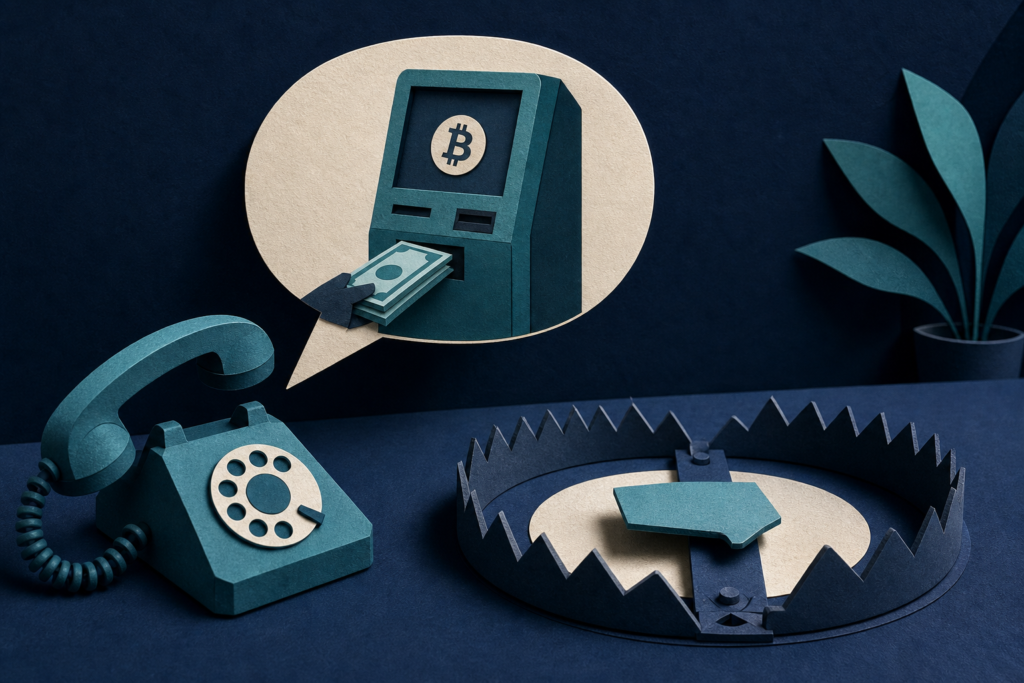
Watch for a caller who claims to be from the police, a government office, a bank, or a company. They may say your account, identity, or computer is in danger. They may tell you to move money somewhere safe, keep the call secret, or go to a particular machine. A request to scan a QR code, a square code read by a phone or ATM, is another serious warning sign.
Do not withdraw money or go to the machine. Hang up, close the popup, and do not call a number supplied in a message or on your screen. If you are unsure, contact the organization using a phone number or website you already trust, or ask a friend or family member to review the story.
How the Bitcoin ATM scam works
A Bitcoin ATM lets people buy or sell digital currency with cash or a card. In this scam, the machine is only the payment tool. The pressure comes from a phone conversation designed to make someone act before checking the claim.
ESET describes callers pretending to be serious officials or trusted workers. They may say someone used your identity, accessed your bank account, or infected your computer. They then keep you on the phone, discourage you from asking for help, and tell you to take cash from your bank.
The caller may send a QR code. Scanning it can direct the machine to send the Bitcoin to an account controlled by the scammer. ESET says these payments are very difficult to reverse and generally do not have the refund process available for a card payment.
The machine may be in a store, gas station, or transport hub, which can make the request look ordinary. Its location does not make the caller’s demand legitimate. ESET says real government agencies, banks, and companies will not tell you to pay them through a Bitcoin ATM.
What ESET reports about the losses
ESET cites FBI figures linking 13,460 crypto ATM scams in 2025 to $389 million in losses. The article says the number rose 23% from 2024 and reported losses rose 58%.
ESET also says people over 50 accounted for more than $302 million in losses in the figures it cites. People over 60 accounted for $257.4 million. These figures describe the reported losses discussed by ESET; they do not mean every victim or payment can be recovered.
The machine is not what makes the demand legitimate. An unexpected request from a stranger to move money through one is a warning sign, especially when the caller uses fear or urgency.
If money has already been sent
Stop communicating with the caller. Keep the ATM receipt, text messages, emails, phone records, and bank transaction details. Contact the ATM operator using the details on the machine or receipt, then contact your bank and explain what happened so they can help secure your accounts.
In the United States, ESET recommends reporting the incident to local police, the Federal Trade Commission, and the FBI’s Internet Crime Complaint Center. Reporting is unlikely to recover the money, but it can help authorities understand fraud patterns. A police report also creates an official record.
Be careful of a second demand. A recovery scam is a follow-up attempt in which someone promises to get the money back for an administrative fee or another payment. ESET warns that these promises are not genuine.
Does this affect me?
- Who may be affected
- Anyone who receives an unexpected call, message, or computer popup directing them to pay through a Bitcoin ATM should care. ESET says older adults are over-represented in the loss figures it cites.
- How to check
- Look for an urgent demand, a threat about your account or computer, instructions to keep the call secret, or a request to scan a QR code. Verify the claim through contact details you find yourself.
- What to do
- Hang up and do not pay. If payment already happened, save the evidence and contact the ATM operator and your bank immediately.
- What to avoid
- Do not withdraw cash for a stranger, scan a supplied QR code, call a number in a popup, or pay anyone who promises recovery for a fee.
Common questions
Would a government agency or bank ask me to pay through a Bitcoin ATM?
No. ESET says real government agencies, banks, and companies will not tell you to pay them through a Bitcoin ATM. Hang up and contact the organization through official contact details.
What if the caller says my computer is infected?
Do not call the number in the popup or follow the caller’s payment instructions. Close the message, use a trusted way to contact a legitimate support provider, and ask someone you trust to review the situation.
Can a Bitcoin ATM payment be reversed?
ESET says these payments are usually very difficult to reverse and do not work like card payments with a chargeback. Contact the ATM operator and your bank immediately anyway, and preserve all records.
What if someone offers to recover my money for a fee?
Treat it as another scam. ESET warns that recovery scammers may ask for an upfront fee and then take more money without recovering the original payment.
Primary source
This article is based on ESET’s September 24, 2026 article, “Been told to pay at a Bitcoin ATM? Read this first,” which cites FBI figures and provides response steps: https://www.welivesecurity.com/en/scams/been-told-pay-bitcoin-atm-read-first/ Read the complete original source.
Concerned this may affect your computer or account?
Bring the exact alert, device, product, and timeline. Leon will help separate urgent action from noise.
Article history: Published Sep 25, 2026 at 10:00 am EDT. Updates and corrections are noted here when material facts change.